Protecting oneself in battle has always been a concern for any soldier, and medieval knights were no exception. In fact, it was their protective armor that helped define them as a military unit and social class. Armoring one’s self during the Middle Ages was a great expense that only the wealthy could afford.
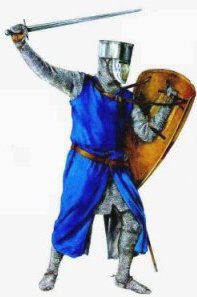
Among the earliest metallic armor to be worn by medieval knights was chainmail armor, consisting of tens of thousands of interlocking rings woven painstakingly by hand to form a shirt, coif, or leggings. Because of the mild steel produced in medieval times each ring had to be riveted to keep all the rings from spreading and opening under the weight of the piece. Underneath the metal armor the knight would wear a padded garment known variously as an “aketon,” or “gambeson.” To this defensive equipment he added a shield, usually made of leather-covered wood, and a helmet (see Knights And Armor’s Helmet Page) . As the medieval arms race progressed and new, more powerful weapons were developed (such as the longbow and crossbow), chainmail became ineffective on its own.

Late in the Middle Ages plate armor began to appear (ca. late 13th/early 14th century), first as reinforcements to vital areas such as the chest and shoulders, and finally as a complete suit (ca. early 15th century). The medieval “knight in shining armor” that most people think of is the fully plate-armored knight. Chainmail armor was now relegated to protecting smaller vital areas that could not be covered with plate armor, such as the groin and under the arms. The shield became smaller, or disappeared altogether as it became unnecessary and redundant.
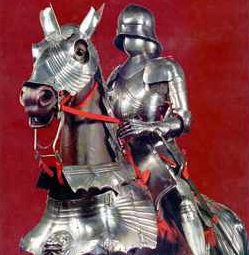
Ironically, it was soon after the development of the full suit of plate armor that the medieval knight’s advantage in battle began to wane. With the effective use of gunpowder weapons (ca. 15th/16th century) the face of combat changed. The cumbersome armor of a knight proved ineffective and impractical against new weapons and tactics. The knight and his plate armor were now relegated to ceremonial duties and displays. These “ceremonial” suits of armor are usually very ornate, featuring extensive fluting, intricate engravings, and other decorative features more at home in the world of fashion than battlefield utility.